

A new study published by Prof Chris Watson and colleagues in Transplant International investigated how commonly occult, or “hidden”, fibrin occurs in deceased donor kidneys and livers, where it may originate, and whether its presence is associated with transplant outcomes.
Fibrin is a protein involved in blood clot formation. Small fibrin deposits, known as microthrombi, have previously been observed in donor organs; however, their prevalence and clinical significance remain uncertain. The study measured levels of D-dimers, which are breakdown products released when fibrin is degraded, in fluid collected during machine perfusion of kidneys and livers from the Consortium for Organ Preservation in Europe (COPE) studies.
The results showed that occult fibrin was common in both kidneys and livers, although the amount varied considerably between organs.
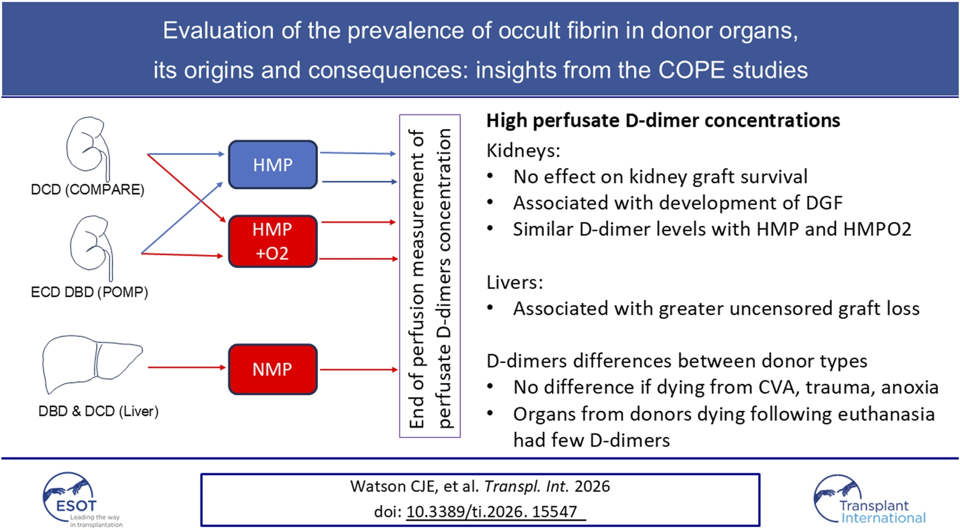
In kidneys donated after circulatory death (DCD) in the COPE COMPARE study, D-dimer concentrations increased substantially during hypothermic machine perfusion, from a median of 91 ng/mL after 15 minutes to 878 ng/mL at the end of perfusion, likely due to the breakdown of existing fibrin microthrombi. Importantly, kidneys that subsequently developed delayed graft function requiring multiple dialysis sessions had significantly higher D-dimer concentrations than kidneys whose recipients did not require dialysis. However, D-dimer levels were not significantly associated with 12-month kidney function or overall graft survival. Oxygenating the perfusion fluid also did not appear to affect D-dimer concentrations.
The findings in liver were particularly noteworthy. Among 95 machine-perfused livers, 91 were subsequently transplanted. When these were divided into groups according to their D-dimer concentrations, transplant failure (defined as graft loss or recipient death) was significantly more likely over two years among livers with the highest D-dimer levels.
The study also investigated where the fibrin might originate. There were no significant differences between organs from donors who died following stroke, trauma, or hypoxia. However, organs from donors who died following euthanasia had substantially lower D-dimer concentrations. This variation according to cause of death supports the possibility that at least some of the fibrin is already present within organs before retrieval, rather than developing solely during preservation.
Pre-retrieval blood samples from 78 QUOD Biobank donors were also analysed to explore the relationship between circulating D-dimers in donors and D-dimers subsequently released from their livers during normothermic machine perfusion.
Overall, the findings suggest that occult fibrin is a common feature of deceased donor organs and may have significant consequences for early kidney function and liver transplant outcomes. This raises the possibility that identifying and potentially removing fibrin during organ preservation could become an avenue for improving transplant outcomes, although further studies are needed.
Read the full article: Evaluation of the Prevalence of Occult Fibrin in Donor Organs, Its Origins, and Consequences: Insights From the COPE Studies