
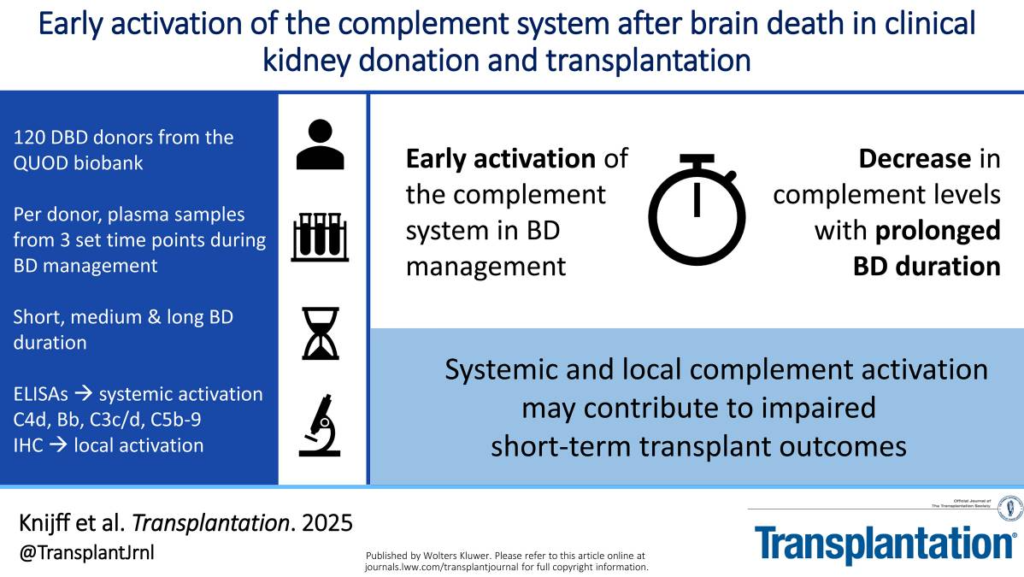
Knijff et al. investigated how brain death (BD) duration impacts complement activation levels using plasma samples and kidney biopsies from the QUOD biobank. This group, led by Professor van Kooten (Leiden University Medical Center, the Netherlands) and Professor Ploeg (University of Oxford) showed that systemic and local complement activation may contribute to impaired short-term transplant outcomes.
Donation after brain death (DBD) has long been the preferred choice of deceased donor type in solid organ transplantation. BD results in an inflammatory response, including activation of the complement system. This protein cascade is part of the innate immune system. While previous studies have identified activation of the complement system in deceased donors, none have specifically studied kinetics of complement activation during donor management following BD. A better understanding of this may help improve donor management, potentially reduce inflammatory injury in the graft-to-be and could reveal novel targets and timing for donor intervention strategies to improve transplant outcomes. The aim of this study was to determine the activation status of the complement system in DBD kidney donors at different time points during BD management.
The researchers used plasma samples and kidney biopsies from 120 DBD kidney donors obtained from the QUOD biobank. In addition, 20 living donor samples were obtained from the Oxford Transplant Biobank as controls. Samples were routinely taken at 3 fixed points during BD management and donors were grouped according to short (≤14 h), medium (15–22 h), or long (≥23 h) duration of BD. Complement activation products C4d, Bb, C3c and C5b-9 were analysed in plasma and at the tissue level.
All complement activation products showed significant higher levels in plasma samples taken just before organ procurement, compared with living donor samples taken at similar timepoint. Complement activation was already observed at the start of donor management and remained elevated. Prolonged BD duration was associated with reduced complement activation. Elevated levels of complement activation factor Bb were associated with increased delayed graft function (DGF), while increased complement activation factor C4d levels showed trends toward higher DGF and lower eGFR at 3 months posttransplantation. Also, renal biopsies taken just before reperfusion, showed local complement activation, with more intense complement staining (C3d and C5b-9) in the vascular pole in kidneys that developed DGF.
Summarizing, this study provides new insights in the dynamics of complement activation in DBD donors. The authors demonstrate that the complement system is activated both systemically and locally following BD and during donor management. Strong complement activation is already observed early on during BD management. Prolonged BD duration was associated with lower systemic complement levels and increased levels of complement activation appear to correlate with short-term kidney function. These findings highlight the importance of understanding complement dynamics and studying them earlier in the donor as well.
Read the full article in the journal, Transplantation.